

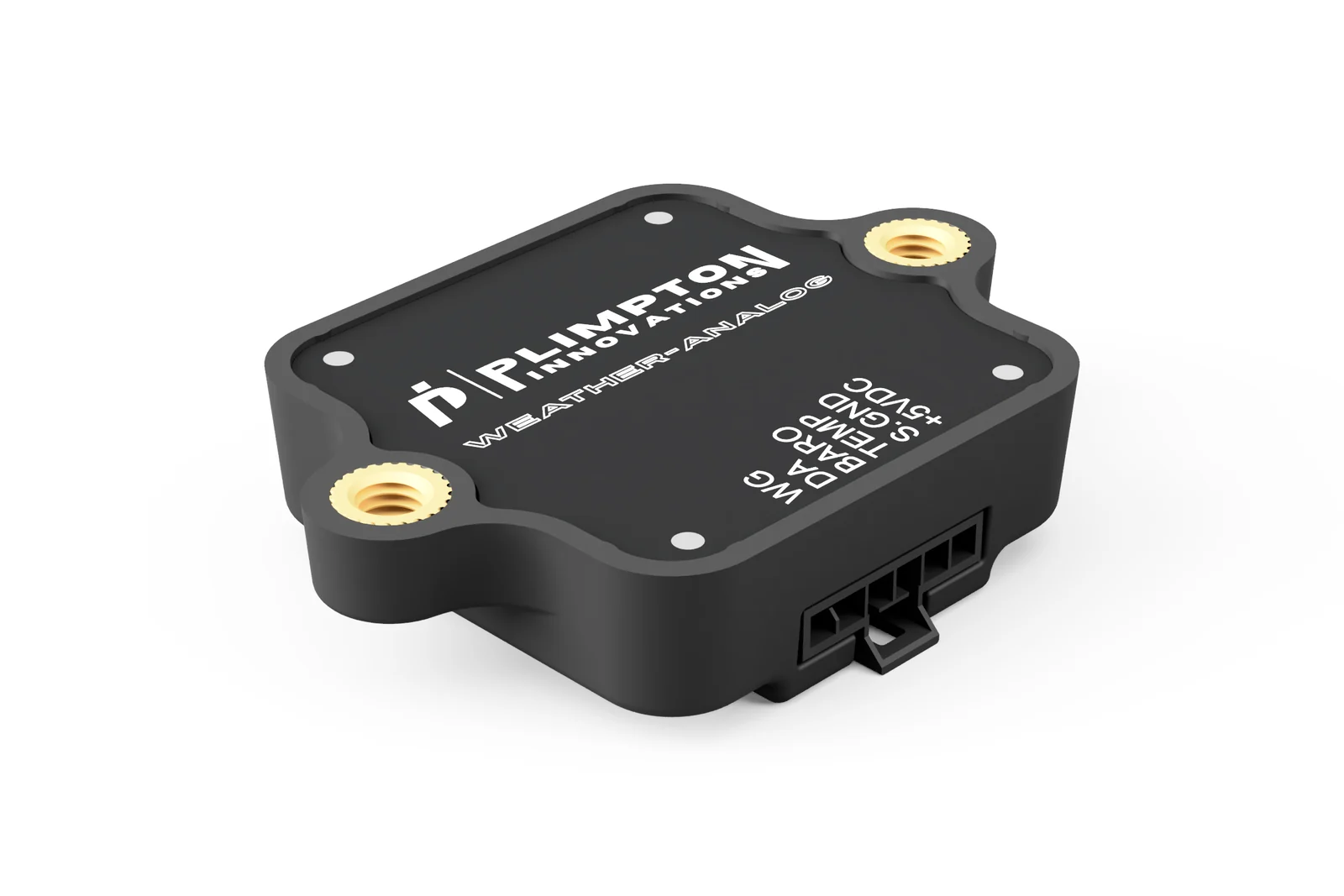
WSANA Atmospheric Sensor, Analog Output
Delivers up to four atmospheric conditions, measured or calculated, to the ECU, data logger or PDM as calibrated 0-5 V analog channels.
Every unit ships with its own calibration record, tied to its serial number.
- Channels
- Up to four
- Outputs
- Calibrated 0-5 V analog channels
- On racing ECUs
- Since 2021
Overview
Horsepower follows air density, and density can shift several percent in a single race day.
A handheld meter shows the reading on a screen; a trailer station sends it to a pager, a phone or a laptop; a phone app pulls it from somewhere else, when there's signal. Each delivers the number to a person, not into the ECU. Many ECU logging programs have a page to type the weather in; someone still has to read it, type it in and remember to save it, every round.
From afternoon into evening the air keeps changing from one round to the next; the tune-up that worked on the afternoon's track, in the afternoon air, may need big changes by the evening rounds to deliver the same performance.
Integration
Mounted on the vehicle, it measures the air at the car, not at the trailer or an airport miles away.
Once set up in the ECU or data logger, the weather is logged as a sensor channel with the rest of the data, so it can't be forgotten or lost.
Standard 0-5 V analog outputs, each scaled linearly across its configured condition, so it wires like any other 0-5 V sensor.
No network, paired device, app, account or subscription needed; measured and calculated on board.
Standard and custom configuration
Ships with a standard four-channel map - Temperature 0-150 F, Barometric Pressure 16-32 inHg, Density Altitude -3000 to 12000 ft, Water Grains 0-150 GPP - or a custom map: up to four of the parameter set, your units and output range, configured to order. Channels are fixed once configured.
Parameter set: temperature, barometric pressure, density altitude, pressure altitude, water grains, air density, relative air density, humidity, dew point, mixing ratio, vapor pressure, specific enthalpy, absolute humidity; metric or imperial chosen at order.
Compatibility
Works with any ECU or data logger that has an analog input configurable for a 0-5 V linear sensor.
Verified with:
- Holley HP
- Holley Dominator
- Haltech Elite Series
- Haltech Nexus Series
- FuelTech FT600
- FuelTech FT700
- MoTeC
- MaxxECU
- Emtron
Using a data logger? Check its manual for the analog input range and whether an adapter or expansion module is required.
For CAN installations, Plimpton Innovations makes WSCAN, a separate product with its own documentation. WSCAN Atmospheric Sensor, CAN Output
Built and Proven
- Designed specifically for motorsports.
- We have been delivering density altitude and water grains to racing ECUs since 2021.
- New WSANA hardware and software add monitoring of its internal and communication paths, self-healing, and closed-loop correction on every analog output.
- A formal functional specification, FMEA, hardware verification plan and validation plan are maintained for WSANA.
- Every unit is individually calibrated and tested before it ships.
- Final assembly, programming, calibration and test are done in-house on every unit.
When Something Goes Wrong
Closed-loop output correction: every analog output is read back and corrected toward its commanded value each cycle in normal operation. In the event of a channel fault being detected, the channel goes to a level below 0.2 V or switches off to protect the analog circuitry, so the ECU can distinguish a faulted channel from a valid signal.
WSANA monitors its internal and communication paths and heals internal faults on its own, including automatic restart. When an output can't reach its target, it keeps correcting; if the fault persists, it concludes the cause is outside the sensor, such as wiring or a low supply, and protects the channel so a stuck output is never interpreted as a valid signal value.
- When one channel is protected, the other channels keep running in closed loop.
- If the output feedback path is lost, outputs stay live in reduced-accuracy operation (LED cyan) instead of going dark.
- If a fault can't be cleared, the unit holds in a defined safe state until a power cycle instead of restarting indefinitely.
- Set your ECU fault zone at or below 0.2 V.
Status LED
| LED | Meaning |
|---|---|
| Red-green-blue self-test, brief green flash | Start-up |
| Off | Healthy |
| Yellow | Self-healing in progress |
| Blue | Wiring or supply fault on a channel |
| Cyan | Reduced-accuracy mode |
| Red | Hard fault |
Specifications
Supply and temperature limits, output protection and accuracy are published in the datasheet.
- Standard map
- Temperature 0-150 F; Barometric Pressure 16-32 inHg; Density Altitude -3000 to 12000 ft; Water Grains 0-150 GPP
- Preferred supply
- The ECU 5 V sensor rail, with ground to the ECU sensor ground (same reference). A separate or floating ground offsets all four channels.
- Power input
- Designed with protection against reverse polarity, transient overvoltage, load dump and ESD
- Output wiring
- Outputs connect only to 0-5 V analog inputs; wiring an output to a source above 5 V damages the output stage.
- Enclosure
- 56.11 x 38.92 x 12.7 mm; two #10-32 UNF threaded inserts on 45.72 mm centers; aluminum roll-cage mount available
- Ships with
- Its own calibration record, tied to its serial number, and a QR code to its documentation page. No manual ships.
- Supply and temperature limits
- In the datasheet
In the Box
- Pigtail harness: sensor pre-terminated, approx. 18 in (460 mm) lead
- Mating connector kit: connector, crimp terminals and terminal lock
- Flat-panel mounting hardware: fasteners, lock washers and standoff spacers
- Calibration record, tied to its serial number
- QR code to the product's documentation page
Documentation
Also at /docs/wsana, the page the QR code supplied in the box opens.
- WSANA manual and datasheet. The list loads from the document register.